
How to Compare Epoxy Garage Flooring Contractors in Tampa Bay Without Getting Burned

Why Tampa Bay Demands More from Garage Floor Coatings
A garage floor in Tampa can look fine right after install, then start bubbling after one wet season. That’s the part homeowners don’t see coming: the slab was holding moisture, and the coating didn’t have a chance.
Heat, humidity, and strong sun are hard on concrete. Bare slabs stain, dust up, and wear down faster than most people expect. The bigger problem is what happens under the surface. Moisture can move up through the slab and push at the coating from below. If the floor wasn’t tested and prepped the right way, the result is often peeling, blistering, or hot-tire damage after a summer of use.
That’s why the first step isn’t picking a color. It’s checking slab moisture and condition before a system is chosen.
Understanding Coating Systems: What Matters for Florida Floors
We typically install a polyurea base with a polyaspartic top coat. That’s the system we reach for most often because it fits the way Tampa Bay garages get used: hot tires, open doors, sunlight, and humidity. The base has to bond to the slab cleanly, and the topcoat has to hold up when the garage sees UV and daily traffic.
That still doesn’t mean every floor gets the same build. Slab condition, moisture, surface repair, and exposure decide the final system. If the concrete is damp, damaged, or already coated, the prep changes. If the space gets strong sun or commercial traffic, the topcoat choice matters even more. We don’t start with a product and hope it fits. We start with the slab and build from there.
Diagram / comparison block
{
  "type": "comparison",
  "title": "Epoxy vs. Polyurea/Polyaspartic for Florida Garage Floors",
  "columns": [
    {"label": "Feature"},
    {"label": "Basic Epoxy"},
    {"label": "Polyurea Base + Polyaspartic Topcoat"}
  ],
  "rows": [
    ["Cure Speed", "Slower cure window", "Faster return-to-service window"],
    ["UV Stability", "Can amber, yellow, or fade in sun", "Better color retention in sunny spaces"],
    ["Flexibility", "More rigid", "More flexible in the finished system"],
    ["Hot Tire Pickup", "Can soften or lift if the floor gets hot", "Built for better hot-tire performance when installed and cured per spec"],
    ["Chemical Resistance", "Good on the right slab", "Strong in a properly built system"],
    ["What We Install Most Often", "Rarely the full system we recommend for Tampa Bay garages", "Our standard installation system for most garage floors"],
    ["Typical Fit in Florida", "Works in some lower-exposure settings", "Best fit for garages that see sun, humidity, and daily use"]
  ],
  "caption": "A simple comparison of basic epoxy and the polyurea-base/polyaspartic-topcoat system we install most often for Tampa Bay garage floors."
}
What a Complete Quote Should Include
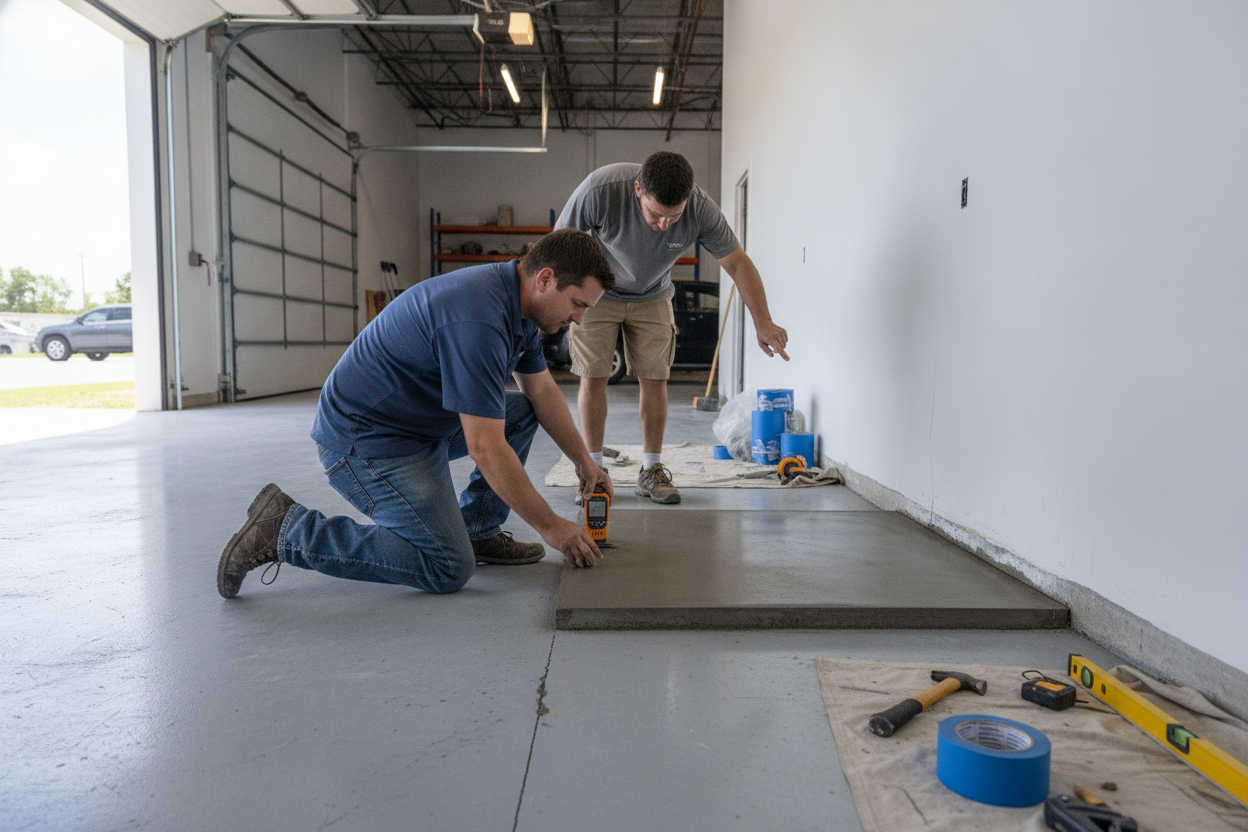
A good garage floor coating quote should read like a job plan, not a price tag. The starting point is a slab inspection and moisture testing. In Tampa Bay, that matters because the coating system has to match the slab’s condition. Moisture limits and prep steps should follow the coating manufacturer’s instructions, not just a sales script.
Here’s what a comprehensive and professional scope of work should include:
- Concrete Inspection and Moisture Testing: Before any coating is applied, the contractor should inspect the slab for existing damage, oil contamination, or previous coatings. They should also test for moisture vapor transmission (MVT). In plain terms, that means checking whether moisture is moving up through the slab. If the test shows the slab is too damp for the chosen product, a vapor barrier or moisture mitigation system may be needed.
- Mechanical Surface Preparation: This is the step that gives the coating something to grip. The concrete should be mechanically profiled, usually with diamond grinders or shot blasters, to the level the manufacturer calls for. That roughens the surface so the coating bonds properly. Pressure washing or acid etching by itself usually isn’t enough.
- Crack and Damage Repair: Cracks, pits, and spalls should be repaired before the coating goes down so the finished floor isn’t built on weak spots.
- Base Coat Application: A professional system usually starts with a resin base coat that bonds to the prepared concrete.
- Decorative Flake Broadcast (if chosen): If you want a flake floor, the flakes are broadcast into the wet base coat to build color, texture, and slip resistance.
- UV-Stable Topcoat Application: A UV-stable topcoat, often polyaspartic, seals the system and helps protect against sun exposure, chemicals, abrasion, and hot tires.
- Curing and Final Inspection: The contractor should tell you exactly when you can walk on it and when you can drive on it, then do a final walkthrough.
- Warranty: The warranty should be written down and cover both labor and materials, with clear terms for peeling, blistering, and hot tire pickup. Coverage depends on the manufacturer, prep level, moisture conditions, and written exclusions.
A contractor who spells all this out is giving you a real scope, not just a quick price.
How to Get a Transparent Quote and Avoid Pitfalls
A good quote should answer the big questions before you have to ask twice. If it doesn’t, ask for the missing details in writing before you compare bids.
What to Ask Every Prospective Contractor:
- "What exactly is included in your quote?" Ask for the prep method, crack repair, coating layers, labor, and warranty terms in writing.
- "How are you preparing the slab?" You want a clear answer about grinding or blasting, not just a vague mention of cleaning.
- "How do you handle moisture testing and mitigation for Tampa Bay slabs?" Ask what test they use, what happens if the slab comes back damp, and whether the product they’re proposing has a stated moisture limit in the manufacturer’s instructions.
- "What specific products will you use for each layer?" Ask for the manufacturer and product name for the base coat, flakes, and topcoat so you know exactly what’s going on your floor.
- "What does your warranty cover, and for how long?" Make sure the answer is in writing and covers the issues that matter most on Florida slabs.
- "Do you have references for floors you installed a few years ago?" Long-term local performance matters more than a polished sales pitch.
- "How long will I be out of the space?" Get the prep time, cure time, and return-to-service window upfront so there are no surprises.
Warning Signs to Watch For:
- Pressure Sales Tactics: If the quote comes with a countdown clock, that’s not a good sign.
- Inability to Provide Specifics: A contractor should be able to explain the process, the products, and the warranty.
- Lightweight Equipment or DIY Mentality: Professional installation takes the right equipment and the right prep. Shortcuts usually show up later on the floor.
What to Expect: Cost of a Professional Garage Floor Coating in Tampa Bay
For a standard two-car garage, a professional garage floor coating usually starts around $2,500. That’s a common starting point, but the final quote should be tied to the slab in front of you, not a generic package price.
Here are a few simple example tiers:
- Basic two-car garage on a clean, sound slab: Usually lands near the starting range when prep is straightforward and repair needs are light.
- Two-car garage with crack repair, coating removal, or added prep: Moves higher because the labor changes before the coating goes down.
- Two-car garage with moisture mitigation or heavier slab repair: Sits at the top end or beyond it, depending on what the slab needs.
- Larger garage or commercial space: Prices rise with square footage, prep time, and access needs.
The biggest price swing usually comes from what the slab needs before the coating can go down. A clean slab with minor repair needs costs less than one with old coating removal, heavy crack repair, or moisture mitigation. Decorative flake, custom color, and upgraded topcoats can also raise the total. Per-square-foot pricing is often tied to those same factors, since prep and repair drive a lot of the labor.
Here’s how the total usually moves:
- Crack repair: Adds cost when the slab has splits, pits, or spalls that need patching before coating.
- Coating removal: Raises the price when an old coating has to be ground off before the new system can bond.
- Moisture mitigation: Can increase the total when the slab shows moisture conditions that call for an additional barrier or treatment.
- Flake broadcast: Adds material and labor when you want a decorative, texture-rich finish.
- Premium topcoats: Increase the price when the system calls for a higher-performance UV-stable finish.
The cleanest way to compare prices is to ask for an itemized quote. If two bids look close on the surface, the prep and warranty details usually tell you why.
One-Day Installation: Is It Possible for Your Tampa Bay Garage?
One-day installs are possible on the right slab with the right system. That’s usually where faster-curing topcoats help speed things up. But fast doesn’t mean automatic. Return-to-service still depends on slab condition, repair scope, ambient humidity, ventilation, and the coating system the contractor is using.
If the slab needs major crack repair, old coating removal, or moisture mitigation, the job may take longer. Cure times matter too, and they’re set by the product, not the schedule on the truck. A good contractor should tell you that upfront instead of promising a one-day turnaround no matter what.
Takeaways for Tampa Bay Homeowners and Property Managers
The floor that fails first is usually the one that was sold too fast. The smart move is to start with the slab, not the color chart.
If you’re comparing options, keep it simple: check the moisture, ask how the slab will be prepped, confirm the product layers, and get the cure time and warranty in writing. That’s the difference between a coating that lasts and one that starts peeling after the first humid season.
Get an on-site moisture assessment and request an itemized written quote that includes the moisture test results, prep method, product names, cure times, warranty terms, and any repair or mitigation work. If you manage a commercial space or shop, coordinate the work around your hours so the coating plan matches your downtime window.
Frequently Asked Questions
How much does a garage floor coating cost in Tampa?
For a standard two-car garage, a professional garage floor coating typically starts around $2,500, and a straightforward job may land in the roughly $2,500 to $5,000 range. The final price depends on slab condition, prep work, coating system, and any repairs or moisture mitigation the floor needs.
Why is polyurea/polyaspartic better than epoxy for Florida?
Polyaspartic is a strong fit for Florida because it holds color better in sunlight, cures faster, and handles hot tire pickup well in the right system. Epoxy still makes sense in some systems, especially as a base coat on a properly prepped slab, but the topcoat choice matters more when the floor gets sun and humidity.
How long does a professional garage floor coating installation take?
Some projects can be finished in one day, especially with a faster-curing topcoat and a slab that doesn’t need major repair. But the timeline depends on prep, moisture conditions, repairs, and ventilation, so not every floor can be turned around that fast.
What should I look for in a contractor's warranty?
Look for a written warranty that clearly covers both materials and labor. It should spell out what happens if the floor peels, blisters, or gets hot tire pickup, and it should also explain any exclusions in plain language.
Can a garage floor coating prevent hot tire pickup?
A quality system with the right topcoat can greatly reduce hot tire pickup. That issue usually shows up when a coating softens under hot tires and starts lifting from the slab, which is why product choice and prep matter so much.